
The choice between manned guarding and technical protection is often treated as a question of cost. A camera or an alarm can look cheaper than a permanent service, and a guard can feel safer because they are physically present. In reality neither solution is good or bad in itself.
The decision comes down to what kind of incident has to be detected, how much time there is to respond, and who can actually take action. A system works when the chain of detection, assessment and intervention has been thought through from end to end.
Technology watches consistently, but does not understand every situation
The great advantage of cameras, sensors, alarms and access control systems is that they operate continuously and by the same rules. They do not get tired, they record precise times, and — properly configured — they can monitor several points at once.
They are well suited to detecting incidents tied to an unambiguous signal: a door opening, movement in a closed area, a missing entry right, a breach of the fence, or a change in a technical status. Footage and log data can also matter for later examination.
The limits of technology appear when the signal has to be interpreted. A motion sensor cannot tell whether the alarm was caused by a genuine intrusion, an animal, the weather or someone working. A camera can show what is happening, but it does not talk to a visitor behaving oddly, does not stop a dangerous process, and does not organise the securing of the site.
So the question is not whether there is a camera, but who watches it, what they do in response to which signal, and how long it takes for someone able to intervene to reach the site.
People can decide and communicate
A human presence adds most where situations cannot be described by simple yes-or-no rules. A guard can judge whether unusual behaviour represents a genuine risk, can communicate with staff and visitors, and can adapt their response to the circumstances.
This matters where there is continuous movement of people and vehicles, in environments prone to conflict, with complex access control, in protecting high-value and easily moved equipment, and at sites where several tasks have to be coordinated immediately after an incident.
People also have limits. One person can only oversee a limited area, attention can fade, and nobody can be at the gate, in front of the cameras and at the far end of the depot at the same time. Given too many duties, a guard’s presence easily becomes a formality.
A permanent guard is therefore no substitute for well-planned lighting, physical protection, cameras or an access control system. In many cases the most robust solution is one where technology extends the guard’s perception, and the person interprets the signal and acts on it.
To decide correctly, examine the whole response chain
A security incident consists of several steps. Something has to detect that a deviation has occurred. Someone has to assess it. A decision on intervention has to follow, and then someone has to reach the site — or already be there.
If any link is missing, the system weakens. Even a good camera does not prevent theft if the footage is only reviewed the next day. An alarm provides no rapid protection if there is no patrol unit available. Equally, an on-site guard cannot respond properly if they receive no signal from a distant area, or have no clear procedure to follow.
During the survey it is therefore worth thinking through: how long it would take to remove or damage the asset; what physical obstacle slows an offender down; how quickly the signal arrives; who receives it; and how long it takes before intervention can happen.
When can a technology-led solution be considered?
Technical protection suits a site that can be securely locked, has little foot traffic, where the critical points can be adequately covered, and where signals are tied to a rapid response. Examples include an office empty outside working hours, a smaller warehouse, or several nearby depots checked by a mobile patrol.
Physical delay matters in this model too. A good lock, adequate fencing, secure storage and lighting buy time to respond. Technology is at its weakest when, after the signal, an offender can remove the protected asset within minutes and without obstruction.
The reliability of the system also needs examining. What happens during a power cut, a network fault, vandalism or a false alarm? Is there backup power, fault notification and verified maintenance? Without answers to these, a technical system appears to work but can become unreliable at the critical moment.
When is a permanent or periodic human presence justified?
Permanent presence can be justified where there is continuous movement of people or vehicles, where immediate on-site decisions are needed, where the risk of conflict is high, or where the protected asset can be removed quickly. The same applies where the call-out time is too long relative to the risk.
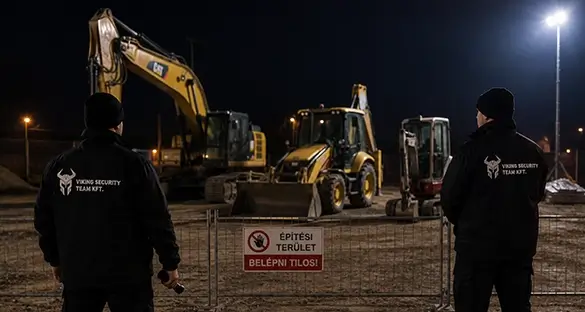
On a construction site, for instance, the extent of the area, the positioning of machinery, fuel and temporary infrastructure all count for a great deal. In a retail unit, visible presence, cooperation with staff and immediate communication may matter more. In an office building, access control, visitor handling and opening and closing come to the fore.
A permanent guard is not always necessary, however. Periodic or randomised patrols can be effective for several depots, out-of-town properties, or periods when the risk rises but continuous presence is not warranted.
Combined protection is often not only stronger but also more economical
The point of a combined system is not to install the most of everything. The aim is for each task to be handled by whichever solution is strongest at it.
Cameras and sensors can watch distant or rarely used areas. An access control system can handle entitlements consistently. The guard can concentrate on personal communication, exceptions and intervention. A mobile patrol can provide physical checks across several sites.
A well-designed system can in this way reduce the periods when a guard has little real work to do, while improving detection where one person could not see everything. This requires technology and manned guarding to be planned not as separate purchases, but as a single operating process.
With camera surveillance, data protection is part of the design
A camera is not only a security device; it can also be a system that involves processing personal data. The purpose of the cameras, their field of view, access rights, the information provided and the retention rules therefore have to be clarified before installation.
The Hungarian data protection authority has drawn particular attention to the fact that the regulatory environment for camera surveillance has changed since the GDPR became applicable, and that retention periods or legal bases cannot automatically be derived from an earlier, general rule. The controller has to establish a documented, proportionate solution matched to the specific purpose.
This matters because a system that works well technically can be flawed from a data protection perspective. A wider field of view than necessary, unrestricted access or unjustifiably long retention does not become lawful merely because it serves a security purpose.
Four questions that help with the decision
When shaping the right model, it is worth working through these four questions:
- What incident has to be detected, and how quickly?
- Who will assess the signal?
- Who can actually intervene, and within what time?
- What happens in the event of a technical fault or a person being unavailable?
Once there are specific answers to these, the discussion is no longer a matter of principle between guard and camera: a security system that can actually be planned begins to take shape.
Choose a working protection model, not a device
The choice between people and technology is rarely black and white. Technology detects and documents well; people interpret, communicate and act. The right balance is determined by the site, the protected asset, the traffic and the response time required.
Viking Security bases its recommendation on an on-site risk assessment: whether permanent guarding, a mobile patrol, a technical system or a combination of these best fits the operation in question.

Have a question? Request a free on-site risk assessment — we survey your property and give you a tailored quote, with no obligation.